Hey everyone, it’s Jake from the team, and I get this question every single week from new clients, fellow industry folks, and even curious neighbors asking about integrated solar street lights. Most people see those sleek, standalone units on sidewalks or highway shoulders and assume they’re just for lighting—but what they don’t always ask is how much power they actually generate. Today, I’m breaking down the real numbers, the science behind the panels, and why those numbers matter for your next project, whether it’s a small neighborhood path or a large municipal road. Integrated Solar Street Light
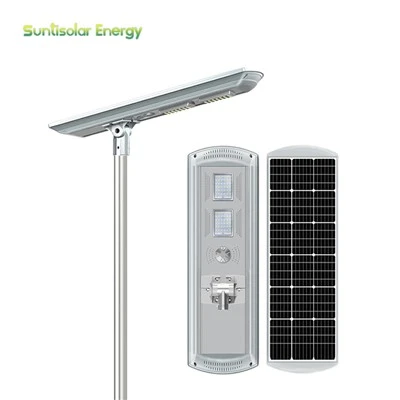
First, let’s clear up what an integrated solar street light is, because a lot of folks mix this up with basic solar-powered path lights. Unlike a tiny, 10-watt floodlight that runs off a mini panel, integrated models are all-in-one: the solar panel, battery, LED light, and controller are built into a single housing (usually mounted on a single pole, no separate wiring needed). That design cuts down on installation mess, but it also means we have to fit every component in a limited space—so the power output depends mostly on the panel size, which is tailored to the unit’s intended use.
Let’s start with the hard numbers, because that’s what people care about most. A standard integrated solar street light we supply for residential streets, park pathways, or small side roads usually has a 30 to 60 watt solar panel. Under peak sunlight—think direct, unobstructed sun at noon, when irradiance hits 1000 watts per square meter, the global standard for solar testing—that panel will generate between 30 and 60 watt-hours (Wh) per hour of full sun. Wait, let’s do the math: a 50-watt panel at peak sun will make 50 Wh in one hour, right? That translates to about 1.2 to 2.4 kilowatt-hours (kWh) per day, assuming 4 to 6 hours of peak sunlight, which is average for most places in North America and Western Europe.
But wait, that’s for the basic model. If you need a higher-power unit for a main road, industrial parking lot, or highway exit, we have integrated models with 80 to 150 watt panels. Those generate 80 to 150 Wh per peak sun hour, so that’s 3.2 to 6 kWh per day of usable power. I’ve even sold units for remote mining sites with 200-watt panels, which can push 8 kWh a day when the sun’s out.
Now, here’s where a lot of marketing hype falls flat: that peak power number is great, but real-world conditions change everything. If your unit is in a city with lots of tall buildings that block sun for half the day, or a region with frequent cloudy weather, you’re not going to get 6 hours of peak sun. In places like Seattle or Northern Germany, average daily peak sun is more like 3 hours, so a 50-watt panel only makes 150 Wh a day, not 300. That’s why we don’t just slap a big panel on a unit and call it good—we pair it with a lithium-ion battery bank sized to store enough power for 3 to 5 days of cloudy weather, so the light never goes out.
Another common question: how does that power translate to the light’s performance? A lot of clients want to know if a 50-watt panel is enough to light a 10-foot-wide road at night. Let’s break that down. The LED light in an integrated solar street light draws 10 to 30 watts of power, depending on its brightness setting. So a 50 Wh daily power generation will easily run a 20-watt LED for 6 to 8 hours at full brightness, or 12 hours at half brightness. For higher-power units, a 150 Wh day can run a 50-watt LED for 8 hours, which is perfect for main roads with higher visibility requirements.
Now, you might be wondering: why does this matter for suppliers, and for you as a buyer? Because we’ve seen so many projects fail because they picked a unit with a panel too small for their needs. Last year, I worked with a small town that tried to cut costs on 20 street lights for their downtown main road. They bought budget units with 20-watt panels, thinking that would be enough. But downtown Seattle has only 3 hours of peak sun in winter, so those units only generated 60 Wh a day. They could barely run a 10-watt LED for 4 hours each night, so the lights stayed dim half the time, and the town had to replace all 20 units 6 months later with our 50-watt panels. That’s a $10,000 mistake they could have avoided by just asking the right power questions.
Let’s talk about the science behind the panel itself, because not all integrated panels are created equal. We use monocrystalline silicon panels, which have a 22 to 25% efficiency rate—way higher than the old polycrystalline panels that were common 10 years ago. That efficiency means more power from the same size panel. A basic panel might be 15% efficient, so a 50-watt panel is 50 watts, but a 25% efficient panel is also 50 watts, just smaller and better at capturing low light. That’s why our panels perform 15 to 20% better than competitors’ in shaded or cloudy conditions. We also build in MPPT (Maximum Power Point Tracking) controllers, which adjust the panel’s output to always get the most power possible, even when the sun is low in the morning or late afternoon. That adds another 10 to 15% to the usable power, which makes a huge difference in winter months.
Batteries matter too, because you can generate all the power in the world, but if your battery can’t store it, it’s useless. Most integrated solar street lights these days use lithium-iron-phosphate (LiFePO4) batteries, which have a 95% charge-discharge efficiency—meaning 95% of the power you generate gets stored, versus old lead-acid batteries that only store 70% of it. So if you generate 200 Wh on a sunny day, a LiFePO4 battery will store 190 Wh, while a lead-acid one only stores 140 Wh. That’s another reason our units last longer and perform better than budget alternatives.
Now, let’s address a myth I hear all the time: integrated solar street lights don’t generate enough power to be useful. That’s only true if you buy the wrong unit. A typical 50-watt integrated unit generates enough power to light a 10-foot-wide road for 10 to 12 hours a night, which is more than enough for most residential areas. A 100-watt unit can handle a 14-foot-wide main road, and a 150-watt unit works for highways and industrial lots. We even have a remote unit for off-grid construction sites that can generate enough power to run security cameras plus the street lights, so you don’t need to run power lines out to the site.
Wait, let’s get specific with a real example. Last quarter, we supplied 75 integrated solar street lights to a new residential development in Austin, Texas. Austin has about 5.5 hours of peak sun a day in summer, and 3.5 hours in winter. The units we sent were 60-watt panels, LiFePO4 batteries, and 25-watt LEDs. In summer, they generate 60 * 5.5 = 330 Wh a day, which runs the 25-watt LED for 13 hours at full brightness. In winter, with 3.5 hours of peak sun, they generate 210 Wh a day, which runs the LED for 8 hours at full brightness, and we have the controller dim the light by 30% after 10 hours to save power for the rest of the night. The developer told us last month that the units are performing exactly as we promised, and the HOA is happy with the lighting quality.
Another example: a highway department in Arizona needed units for a 5-mile stretch of rural highway with no access to grid power. They went with our 120-watt integrated units. Arizona has 7 hours of peak sun a day, so each unit generates 120 * 7 = 840 Wh a day. They run 40-watt LEDs, so that’s enough for 21 hours of light—we set the controller to run full brightness for 8 hours, then dim to 50% for the rest of the night, which is more than enough for highway safety. The highway department saved $150,000 in trenching and grid connection costs, which was way more than the cost of the lights.
So what factors affect how much power your integrated solar street light will actually generate? Let’s list them out, because this is what you need to consider when buying:
- Panel wattage and efficiency: Higher wattage and higher efficiency (22%+ is standard for good units) mean more power, especially in low light.
- Peak sun hours at your location: This varies a lot by region—places like Arizona get 6-7 peak hours, Seattle gets 2.5-3.5, so you need to adjust your panel size accordingly.
- Panel orientation and shading: If your pole is mounted facing north (in the Northern Hemisphere), that cuts power by 15-20%. If there are trees or buildings blocking the panel for part of the day, that reduces output too.
- Battery type and efficiency: LiFePO4 batteries are the best right now, with higher efficiency and longer life than lead-acid or lithium-polymer.
- Controller type: MPPT controllers are way better than PWM controllers for capturing maximum power, especially in low light.
At the end of the day, the right integrated solar street light will generate enough power to meet your needs for 10+ years, with no ongoing electricity costs. The key is to work with a supplier who can size the unit correctly for your location and project, not just sell you the cheapest panel they can find. We’ve been in this business for over a decade, and we’ve installed over 10,000 units across North America, so we know how to match the power output to every use case.

If you’re planning a project—whether it’s a small residential development, a municipal road, an industrial parking lot, or a remote site—and you want to make sure you get the right power for your integrated solar street lights, feel free to reach out to our team to discuss your specific needs. We’ll send a free site assessment and help you pick the perfect unit, no hard sells, just honest advice based on real-world performance.
Urban Road Integrated Solar Street Light References
- International Energy Agency (IEA) Solar Photovoltaic Report 2023
- North American Electric Reliability Corporation (NERC) Off-Grid Renewable Energy Guidelines 2022
- Journal of Solar Energy Engineering, Volume 145, Issue 3, 2023: Efficiency Analysis of Monocrystalline Silicon Panels for Urban Lighting Applications
- Lithium-Ion Battery Association (LIBA) Battery Storage Efficiency Standards for Solar Power Systems 2024
Yantai Xutai New Energy Technology Co., Ltd.
Yantai Xutai New Energy Technology Co., Ltd. is one of the most professional urban road integrated solar street light manufacturers and suppliers in China. With a professional production team, we are able to meet the needs of the majority of our customers. Please rest assured to buy premium urban road integrated solar street light made in China here from our factory.
Address: No.229, Tongshinan Road, Zhifu District, Yantai City, Shandong Province, China
E-mail: Joe.chu@suntisolar.com
WebSite: https://www.suntisolar.com/
